The oral section is 60% of your CPTE mark and it runs first. Ten cases, 15 minutes each, three questions answered aloud to examiners who will not prompt you. This is how we prepare you for it.
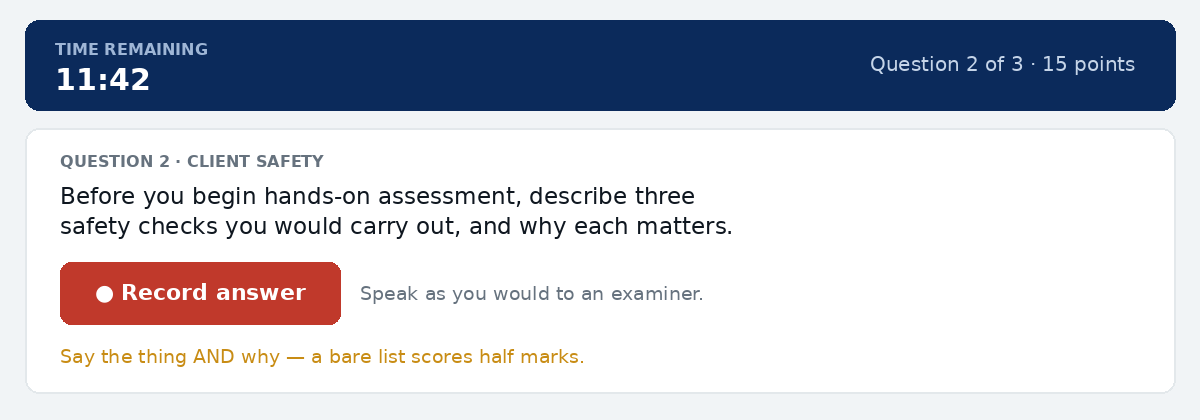
34 sessions across the cohort. Cases are built like the real exam's — client profile, clinical scenario, three questions in domain order. One candidate answers, the instructor marks aloud against the sheet, everyone hears where the marks went and why.
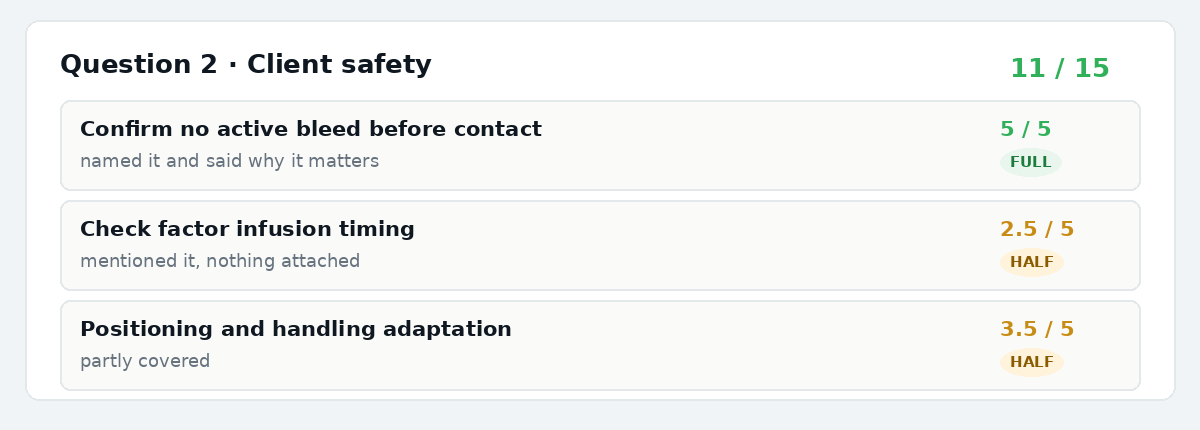
Read the case, plan, record your answer to each question. Within minutes you see your transcript and a pointer-by-pointer score against the examiner sheet — full, half or missed for every point — with a second-examiner score attached.
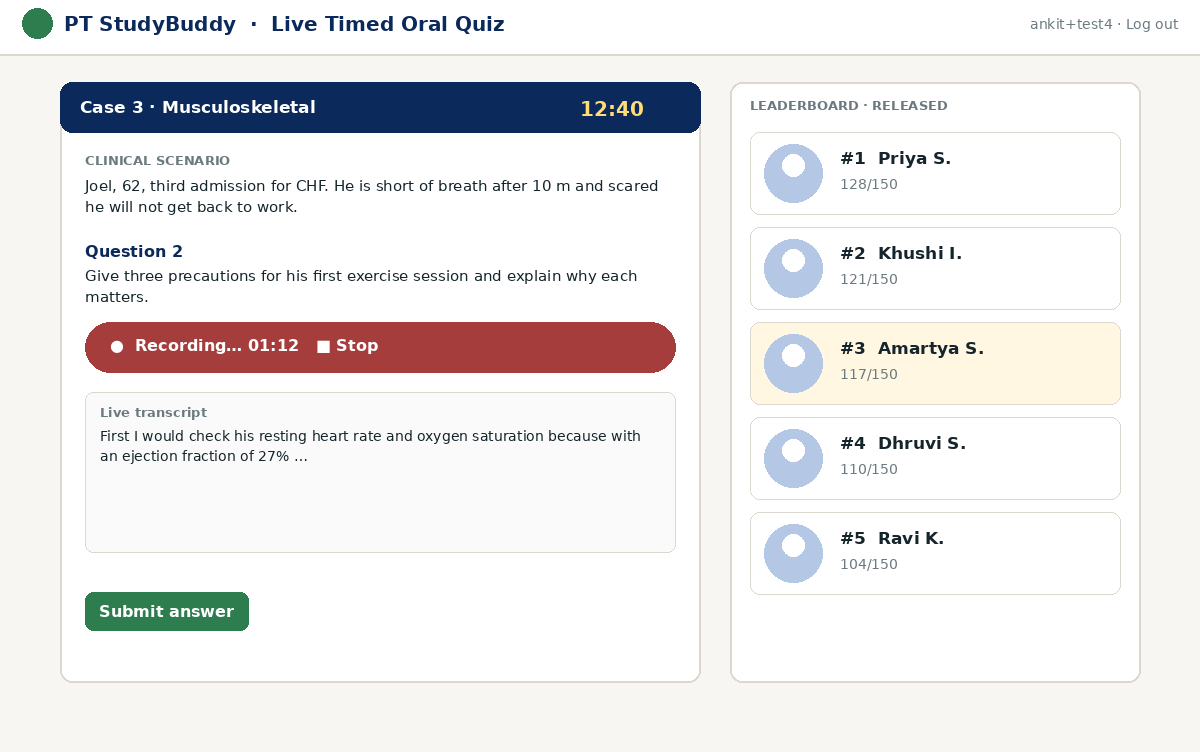
A case opens for a fixed window. One attempt, exam pace, then your report and your place on the cohort leaderboard.
A complete case in the real exam's layout. Press Start, read, plan, then answer each question aloud — your browser transcribes it — or type. After 15 minutes, or when you finish, the examiner's pointers appear and you mark yourself. Nothing is saved or sent anywhere.
| Client | Mrs. Halyna Kowalczyk, 68 years old |
| Setting | Orthopaedic ward, community hospital, Ontario. Post-operative day 5. |
| Reason for admission | Elective right total hip arthroplasty, posterior approach, for end-stage osteoarthritis |
| History | Hypertension (well controlled); type 2 diabetes on metformin; osteopenia. No previous falls. Uses reading glasses. |
| Social | Widowed, lives alone in a two-storey house; bedroom and only bathroom upstairs, 14 stairs with a rail on one side. Daughter lives 20 minutes away and works full time. Independent with all ADLs and driving before surgery. |
| Current status | Pain 4/10 at rest, 7/10 walking. Mobilising 30 m with a two-wheeled walker and standby assistance. Night nurse reports she was disoriented at 03:00 and tried to get out of bed unaided; oriented again by morning. Discharge home planned in 48 hours. |
| Observation | Right hip dressing dry and intact; mild thigh swelling, calf soft and non-tender; right leg in slight external rotation at rest |
| Objective |
|
You are the physiotherapist responsible for her discharge planning. The surgical team considers her medically ready. Her daughter, visiting at lunch, asks you privately whether her mother is "really safe to go home on Thursday" and whether she should take unpaid leave to move in for two weeks.
1. Assessment and diagnosis · 25 marks
Identify four findings from the assessment that most influence whether she can be discharged home safely, and for each explain why it matters at post-operative day 5.
2. Client safety and client-centred care · 15 marks
Describe three specific measures you would put in place before her next mobilisation session to reduce her risk of dislocation or a fall on the ward, with the reasoning for each.
3. Professional responsibilities, collaboration and communication · 60 marks
New development: Later that afternoon the occupational therapist tells you the home assessment cannot happen before Thursday. The daughter repeats her question and adds, "You can just tell me — she'd want you to."
Say the thing and why. A bare list earns half marks.
In the program every recorded answer is transcribed and scored against the examiner sheet automatically, pointer by pointer, with a second-examiner score, and instructors review any case a student flags. This page is a taste of the format; the marking here is your own.
Already enrolled in the written course, or want oral only? Email us for the oral-only fee.
Every case in the bank can be attempted three times with scoring; after that you can still read it. The bank grows through the cohort, and live timed oral quizzes add a new case each week.
Your recording is transcribed and the text is marked against the case's examiner sheet, pointer by pointer. Naming a point earns half; naming it with the reason earns full. A second-examiner score is attached to every attempt. Instructors read every report a student flags.
Yes: a written client profile and clinical scenario, three questions covering the domains the exam blueprint specifies, answered aloud in order within 15 minutes, with no prompting. Live sessions add the one thing a recording can't — an instructor stopping you mid-answer to show what an examiner would have marked.
Yes. Email us — the oral-only fee depends on whether you're already enrolled in the written course.